
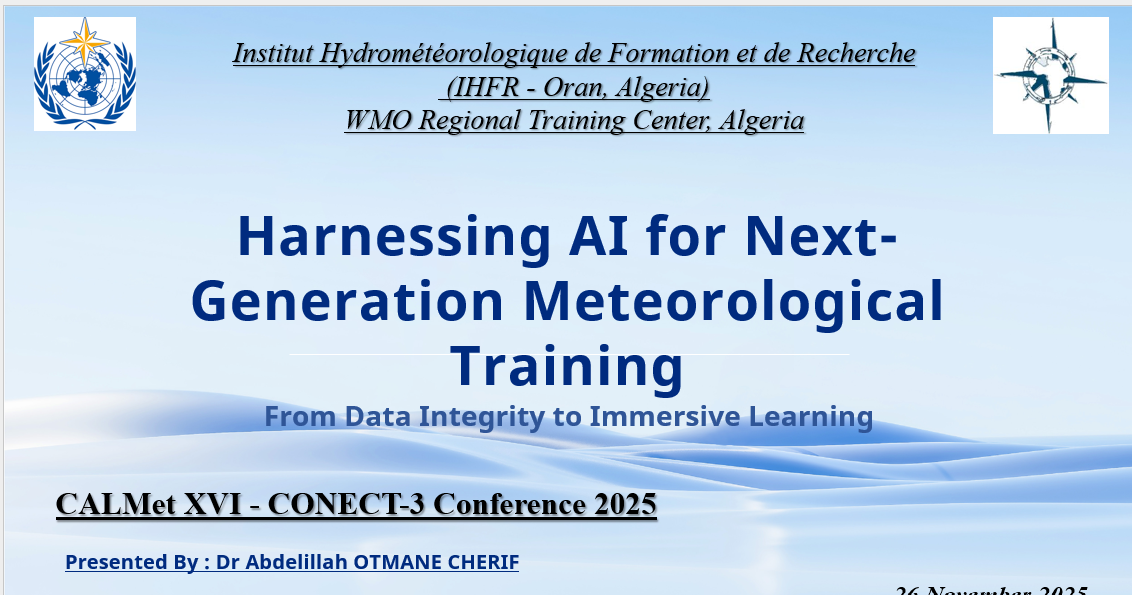
0800 - 0830 UTC (30') 0900 - 0930 CET Harnessing (AI) Artificial Intelligence for Next-Generation Meteorological Training: From Data Integrity to Immersive Learning (Abdelillah Otmana Cherif - IHFR - Algeria)
The accelerating pace of climate change and the growing demand for reliable meteorological and hydrological services highlight the urgent need to modernize training approaches in our field. Traditional pedagogical methods, while essential, are no longer sufficient to prepare professionals for increasingly complex, data-intensive, and rapidly evolving operational environments. Artificial Intelligence (AI) and emerging digital technologies now offer unprecedented opportunities to bridge this capacity gap by enabling interactive, adaptive, and immersive learning experiences.
This presentation examines how AI can be systematically integrated into meteorological and hydrological training, drawing upon my expertise in mathematics, machine learning, and hydrometeorology, as well as recent educational developments at the Institut Hydrométéorologique de Formation et de Recherches (IHFR). I will explore three key domains where AI is reshaping the way we learn, teach, and assess competencies:
- Interactive and Immersive Learning
- Data-Driven Training and Assessment
- Ethics, Reliability, and Trust in AI Integration
The presentation will share practical lessons learned from developing and implementing AI-supported modules at IHFR, emphasizing both the opportunities for enhancing learner engagement and the challenges related to data quality, digital infrastructure, and institutional readiness. A key message is the continued importance of human oversight: AI should augment, not replace, the educator. The role of instructors as mentors, interpreters, and ethical stewards remains central.
By the end of this presentation, you will gain a clear and actionable vision of how AI can be responsibly adopted as a catalyst for innovation - strengthening the integrity, reliability, and inclusiveness of meteorological training. This aligns with the broader WMO mission: preparing a new generation of meteorologists and hydrologists who are both technically skilled and capable of critically engaging with the digital tools shaping the future of climate and weather services.
Please click the image below to download the presentation.
Thank you,
Abdelillah Otmana Cherif - IHFR