
1745 - 1815 UTC (30') Strengthening Regional Collaboration through the WMO-CGMS VLab Pilot Project supporting the Early Warning for All Initiative: Sharing experiences and best practices among regional Training Centres of Excellence (Diego Souza - INPE)
1745 - 1815 UTC (30') Strengthening Regional Collaboration through the WMO-CGMS VLab Pilot Project supporting the Early Warning for All Initiative: Sharing experiences and best practices among regional Training Centres of Excellence (Diego Souza - INPE)
Slides shared during the virtual presentation: DOWNLOAD
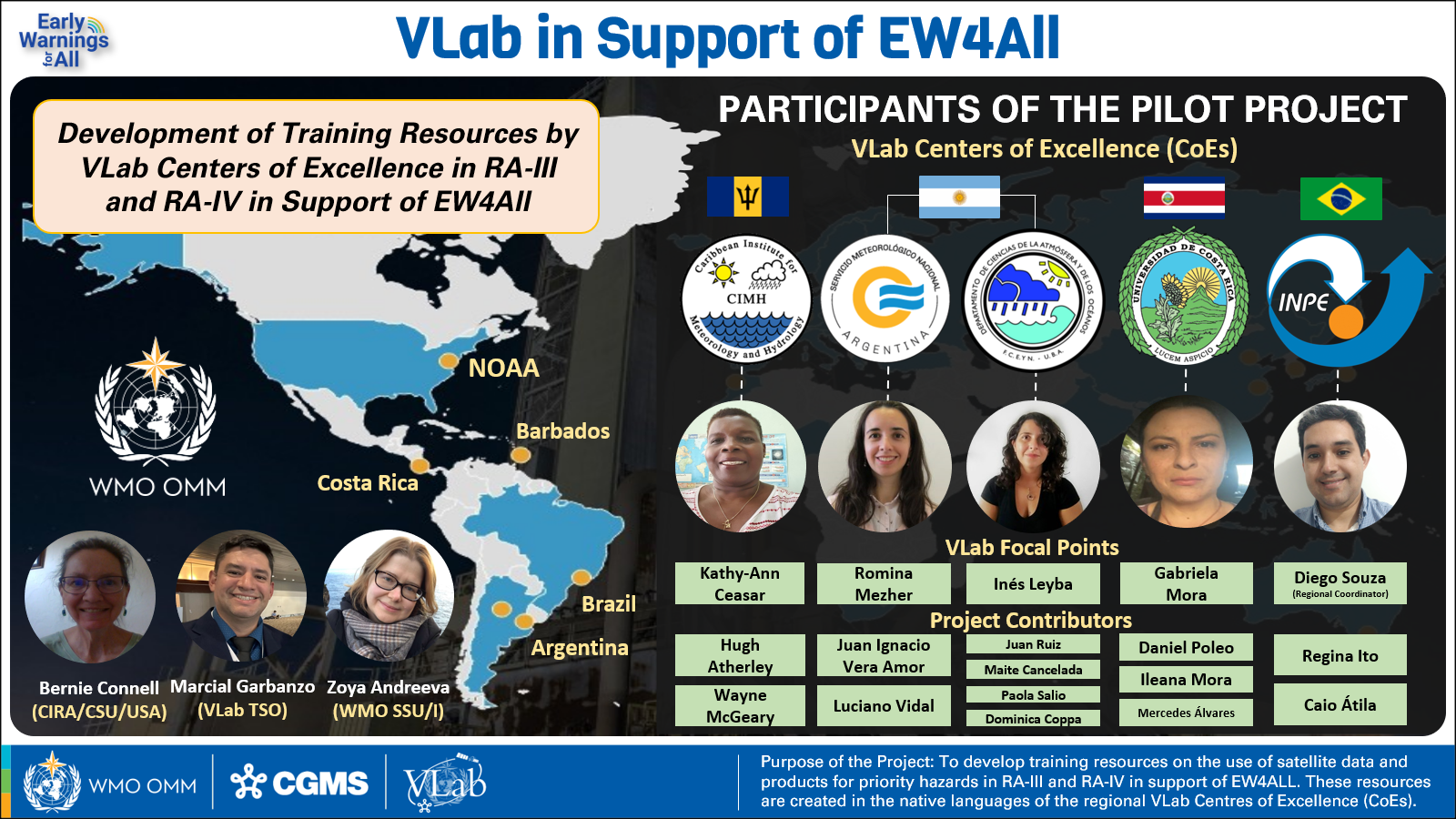
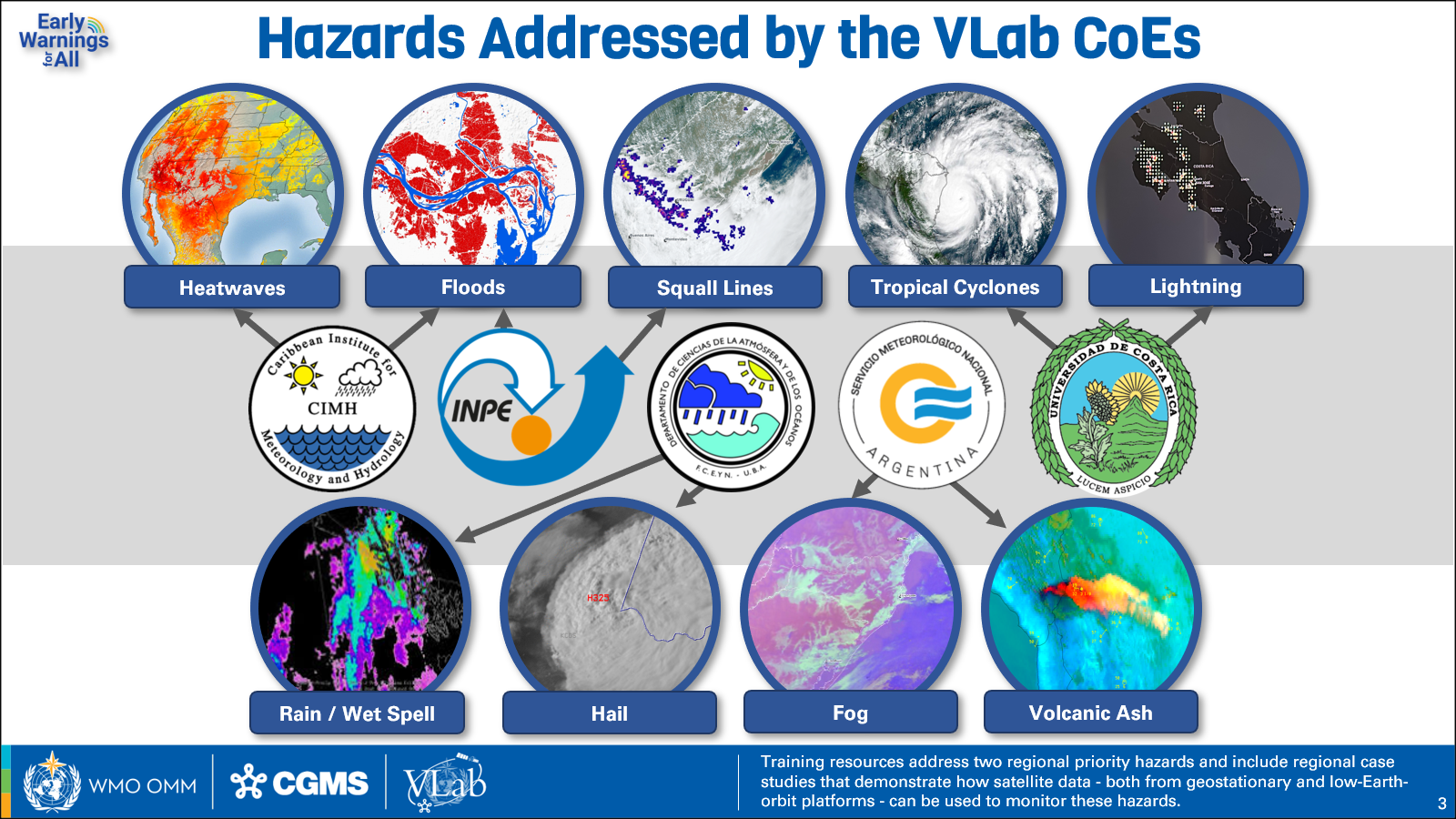
The World Meteorological Organization (WMO) promotes the "Early Warnings for All" initiative with aims to ensure universal protection from hazardous hydrometeorological, climatological and related environmental events through life-saving early warning systems by the end of 2027, a call echoed by the United Nations Secretary-General António Guterres in 2022.” Pillar 2 of EW4All, led by WMO, focuses on detection, observation, monitoring, analysis, and forecasting, leveraging space technologies to enhance early warning capabilities. To support this effort, the Virtual Laboratory for Education and Training inSatellite Meteorology (VLab) under the WMO and the Coordination Group forMeteorological Satellites (CGMS) launched a collaborative pilot training initiative in 2024 for WMO Regional Associations III & IV that cover North, Central, and South America and the Caribbean. Using information gathered from a WMO rapid assessment survey of priority hazards for member countries, the initiative supports VLab Centres of Excellence in Argentina, Barbados, Brazil, Costa Rica to provide training materials to cover at least two priority hazards, fostering collaboration among diverse stakeholders to produce accessible, regionally tailored resources. The participating VLab Centers of Excellence (CoEs) include the Caribbean Institute for Meteorology and Hydrology (CIMH) in Barbados, Brazil’s National Institute for Space Research (INPE), the University of Buenos Aires’ Department of Atmospheric and Ocean Sciences (DCAO), Argentina’s National Meteorological Service (SMN), and the University of Costa Rica, developing training materials focusing on hazards like floods, heatwaves, hail, tropical cyclones, squall lines, fog, volcanic ash, and lightning. Each Centre is responsible for organizing case examples and preparing the resources in their native language.
Contributions from the Regional Centres of Excellence:
CIMH Barbados
Moodle: https://my.cimh.edu.bb/course/view.php?id=233
Self-Enrollment Key: CIMH-EW4ALL
CALMet Stack: https://my.ltb.io/www/#/stack/ACNJI
DCAO-UBA Argentina
Moodle: https://campus.exactas.uba.ar/course/view.php?id=788
Select “Entrar como persona invitada” - Self-Enrollment Key:
dcao_ew4all
CALMet Stack: https://my.ltb.io/www/#/stack/ACNGR
INPE Brazil
Moodle: https://moodle.cptec.inpe.br/course/view.php?id=38
Self-Enrollment Key: EW4ALL2025#
CALMet Stack: https://my.ltb.io/www/#/stack/ACNCF
SMN Argentina
Moodle: https://crf.smn.gob.ar/course/view.php?id=267
Self-Enrollment Key: VLAB_EW4All
CALMet Stack: https://my.ltb.io/www/#/stack/ACNIZ
Note: Our colleagues from UCR - Costa rica will share the Moodle link in the near future.
VLab: Shared Guidance and Resources from the WMO-CGMS VLab
to Support the Early Warnings for All Initiative (and Other Training Activities)
CALMet Stack: https://my.ltb.io/www/#/stack/ACNJN
You are welcome to explore the Moodle trainings and CALMet stacks created by our project participants!